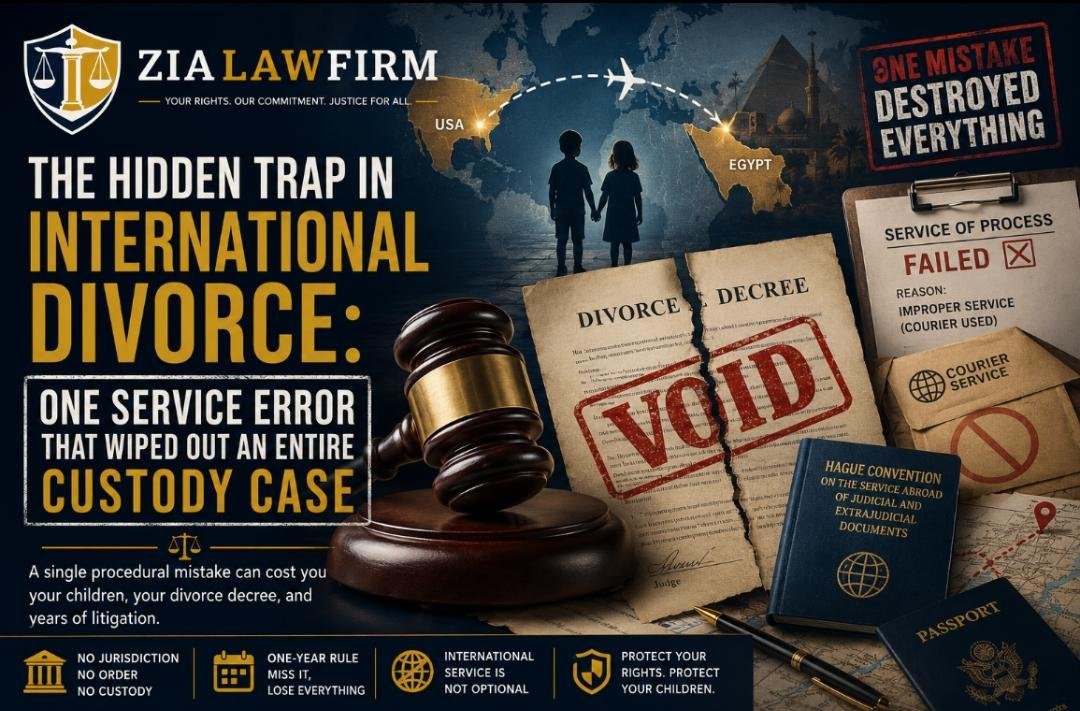
A single procedural mistake can cost you your children, your divorce decree, and years of litigation.
When George Tadross filed for divorce in an Ohio courtroom, he probably thought he had done everything right. His wife had taken their two children to Egypt and refused to come back. He went to court, got a divorce, was named the residential parent, and even obtained an order for his wife to pay his legal fees.
It all seemed like a victory.
Until the Ohio Court of Appeals stepped in and vacated everything.
Not just part of the ruling. Not just the custody order. The entire case was declared void. The divorce never happened. The custody order never existed. The property division was meaningless.
Why? Because George's lawyer used a courier service to serve his wife with divorce papers in Egypt.
And that single decision destroyed his entire case.
The International Service Trap
This case, Tadross v. Tadross (2017), serves as a brutal reminder for anyone involved in international family law: proper international service of process is not a suggestion—it is an absolute requirement that can make or break your case.
What happened in this case?
- George Tadross filed for divorce in Ohio
- His wife Maryan took their two children to Egypt and refused to return
- The trial court granted the divorce and named George the residential parent
- Maryan appealed, arguing she was never properly served
- The Ohio Court of Appeals agreed and vacated everything
The Problem: Egypt is a signatory to the Hague Convention on the Service Abroad of Judicial and Extrajudicial Documents, and Egypt has specifically objected to Article 10 of that treaty, which would have allowed service by postal channels.
In plain English: you cannot simply mail divorce papers to someone in Egypt or send them by courier. Egypt requires service to go through its designated Central Authority. Anything else is legally meaningless.
The "One-Year Rule" That Killed the Case
Here's the kicker that made this case devastating for George Tadross:
Under Ohio law (and similar rules in many states), a civil action only "commences" if service is obtained on the defendant within one year of filing the complaint.
Because George's attempted service via courier was invalid, it was as if he had never served his wife at all. And by the time the appellate court ruled, more than a year had passed since the complaint was filed.
The action never legally existed.
No action = no jurisdiction = no divorce = no custody order.
Everything—and I mean everything—was wiped out.
The One-Year Rule: In many states, you have one year from filing to perfect service. Missing that deadline means your action never "commences." In Tadross, the invalid service meant the case never legally existed.
The Cost of Getting It Wrong
Let's be clear about what this means in practical terms:
| What George Lost | Why |
|---|---|
| The divorce decree | The court never had jurisdiction over Maryan |
| Custody of the children | The custody order was void from the start |
| Property division | The court couldn't divide property without jurisdiction |
| Attorney fee award | Completely voided |
| Four years of litigation | George has to start over from scratch |
| Time with his children | Maryan remains in Egypt with the children |
And here's the cruelest part: Maryan's active participation in the case—she hired lawyers, filed motions, and defended herself—did NOT waive her right to challenge service.
Critical Principle: Raising the defense of insufficient service in your answer preserves the issue forever. You can fight the case on the merits and still successfully argue later that the court had no jurisdiction over you.
How a Lawyer Can Ruin Your International Divorce
This case isn't about a clever legal strategy from the wife's attorneys. It's about a fundamental mistake by the husband's lawyers that any competent family lawyer should have avoided.
The minimum due diligence for international service:
- Check if the destination country is a signatory to the Hague Service Convention
- Check if that country has objected to Article 10 (which would bar postal or courier service)
- Follow the required method—usually through the Central Authority
- Translate documents into the official language of the destination country
- Track the service timeline—remember the one-year commencement rule
In Tadross, Egypt had made its objection clear. A simple Google search would have revealed that service must go through the Central Authority. Instead, someone chose the cheaper, faster option—a courier service—and it cost George everything.
The International Child Abduction Connection
Tadross is also a chilling reminder of why the Hague Convention on the Civil Aspects of International Child Abduction exists.
Maryan took the children to Egypt and refused to come back. That's exactly the kind of behavior the 1980 Hague Abduction Convention was designed to address.
But here's the problem: even if you file a Hague Convention case seeking the return of your children, you need to get proper service on the abducting parent.
The same service rules apply.
If you can't properly serve the abducting parent in their new country, your Hague case will fail before it even starts.
Warning: The Hague Service Convention applies to Hague Abduction cases too. Improper service in an abduction case means no jurisdiction—and no return of your children.
What Should You Do If Your Ex Takes the Children Abroad?
Step 1: Act Fast
The Hague Convention has a one-year rule for expedited return. If more than a year passes before you file proceedings, the court can refuse to return the child if they've become "settled" in the new environment.
Step 2: Get Proper Service
- Identify the country where the children are
- Check Hague Service Convention status
- Use the Central Authority if required
- Don't take shortcuts
Step 3: Consider a Hague Abduction Case
- This is the primary tool for international child return cases
- It applies in 103 signatory countries
- It requires a showing that the child was wrongfully removed from their "habitual residence"
Step 4: Consult a Specialist
- International family law is complex
- One mistake can cost you the case
- Get a lawyer who understands both domestic and international rules
Countries That Object to Article 10
The U.S. has not objected to Article 10, meaning service from abroad can sometimes be made by mail. But that doesn't help you when you're trying to serve someone in countries that have objected.
| Country | Service Requirements |
|---|---|
| Egypt | Central Authority only |
| China | Central Authority only |
| Japan | Central Authority only |
| Greece | Central Authority only |
| Germany | Central Authority (with limited exceptions) |
Every country is different. You need to research each one individually. What works in one country may be invalid in another.
Key Takeaways for Anyone Facing International Divorce
- Service is everything. If the court doesn't have personal jurisdiction over your spouse, everything else is meaningless. No divorce. No custody. No property division.
- The Hague Service Convention is the law of the land. It preempts state rules. What your state allows by courier doesn't matter if the destination country requires Central Authority service.
- Nationality doesn't matter. Whether your ex is a U.S. citizen or not, if they're physically in a foreign country, that country's service rules apply.
- The one-year clock is ticking. In many states, you have one year from filing to perfect service. Missing that deadline means your action never "commences."
- Active participation doesn't waive service defects. If your ex raises the defense of insufficient service in their answer, they can participate fully in the case and still challenge jurisdiction later.
- Don't take shortcuts. Using a courier instead of the Central Authority might save time and money—but it can cost you everything.
What This Means for Parents
If you're the left-behind parent (seeking return):
- Act immediately—the clock is ticking
- Get proper service on the abducting parent
- Consider a Hague Convention application through the Central Authority
- Document everything—the child's habitual residence, the removal, the service attempts
- Don't let delays become the enemy—the longer it takes, the stronger the "settled" defense becomes
If you're the parent who left (opposing return):
- You can raise service defects as a defense
- You can argue the "settled" defense after one year
- You can argue the child's objections if they're mature enough
- You can argue "grave risk of harm" if returning would be dangerous
But be warned: Raising these defenses doesn't guarantee victory. Courts are increasingly skeptical of parents who take children across borders without permission.
Final Thoughts: Why Proper Service Matters
Tadross v. Tadross isn't just a case about service of process. It's a case about the consequences of cutting corners in international litigation.
George Tadross thought he had a good case. His wife had taken the children to Egypt and refused to come back. The trial court agreed with him and granted him everything he asked for.
But because the service was invalid—because someone used a courier instead of Egypt's Central Authority—the entire case was void.
Four years of litigation. Countless attorney fees. Emotional turmoil. And at the end of it all: nothing.
George has to start over. He has to serve his wife properly, which means going through Egypt's Central Authority. He has to file a new case, wait for service, and hope that the courts will still hear his claims.
And in the meantime, the children remain in Egypt, building a life there.
The Bottom Line: International service of process isn't optional. It isn't a suggestion. It's a fundamental requirement of due process that—if violated—destroys everything.
What You Need to Do
If you're facing an international divorce or custody dispute, here's what you need to do:
- Hire a specialist—not just any family lawyer, but someone who understands international family law
- Research service requirements—every country is different
- Use the Central Authority—don't take shortcuts
- Document everything—every step, every translation, every attempt
- Act fast—remember the one-year rule
- Consider a Hague Convention case if there's been an international abduction
- Don't assume anything—citizenship, residency, and jurisdiction are complex issues
One procedural mistake can cost you your children, your divorce, and everything you've fought for.
Don't let that happen to you.
Disclaimer: This article is based on Tadross v. Tadross, 2017-Ohio-930, and related cases including Abbott v. Abbott, 560 U.S. 1 (2010), Volkswagenwerk Aktiengesellschaft v. Schlunk, 486 U.S. 694 (1988), and the Hague Convention on the Civil Aspects of International Child Abduction and the Hague Service Convention. This article is for general informational purposes only and does not constitute legal advice. For advice specific to your situation, consult a qualified family lawyer in Peshawar, lawyer in Islamabad, or wherever your matter is being handled.
Facing an International Divorce or Custody Dispute?
Our specialist family lawyers in Peshawar and family lawyers in Islamabad are available for confidential consultations — in person, by phone, or online.